







How investing with Carbon Equity works
Why Private Markets
Capture more opportunities
Many portfolios seek returns through the stock market alone. Adding a modest private equity allocation has improved returns in almost every ten-year period this century.*
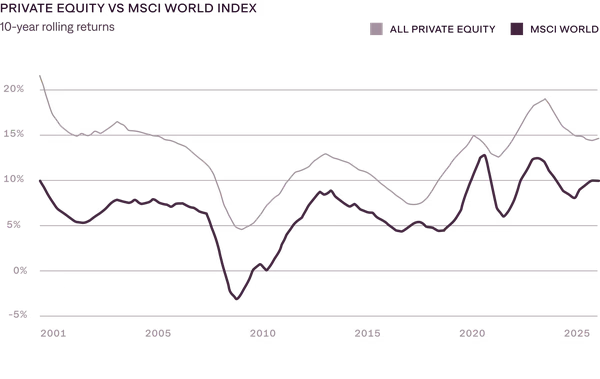
* Performance from the past is no guarantee for the future.
You may lose some or all of your investment. (Bain & Company 2025, MSCI)
Our offerings
Two ways into private markets
Our investment team tracks the investing landscape, surfacing the top opportunities coming to market. Our due-diligence process means only the select few earn a spot on the platform.


You invest in a Carbon Equity portfolio fund alongside other investors.


Your capital is diversified into multiple funds, each specialized in different sectors, geographies, and stages.


You invest in 40 to 150+ companies or projects, depending on the portfolio fund you choose.


You invest in a Carbon Equity co-investment fund alongside other investors.


You invest directly in handpicked companies from across our funds.
Our Due Diligence
Fewer than 5% meet our standards
Our investment team tracks the investing landscape, surfacing the top opportunities coming to market. Our due-diligence process means only the select few earn a spot on the platform.





Universal screening
A constant overview of the global investing landscape
First scan
An initial scan to assess wether an opportunity meets our standards
Impact due diligence
A proprietary framework used to assess an opportunity's impact potential
Financial due diligence
An in-depth assessment of team structure, strategy and past performance
Investment committee approved
Requires a unanimous vote to get in
Universal screening
First scan
Impact due diligence
Financial due diligence
Investment committee approved
Built on decades of experiences at









how your money moves
Private market investments behave differently from public ones
Your total commitment is paid in over several years, the value of your investment will fall before it rises, and distributions come back unevenly across a decade. This is the J-curve, and it is normal for the asset class: fees are paid while the portfolio is still young, then returns arrive as investments mature and exit.
Year 0
Commitment
You commit a total amount. Your first capital call follows once the fund reaches its next close, and its size depends on the fund and how much you have committed.
Years 0-4
Investment period
Your capital is put to work as the underlying funds invest. The value of your investment will fall during these years. Around year four, this reaches its lowest point. That is the bottom of the J-curve, and it is where the line turns.
Years 5-11
Distribution period
The underlying funds begin exiting companies, through a sale or IPO, and the proceeds come back to you as distributions. On average, investors receive distributions equal to their initial investment within five to seven years, and profits arrive after that.
Important risk warning: this is a representation of the average cash flow of a private equity fund. This is a high-risk investment and you may lose some or all of your investment. No specific cash flow is guaranteed, and this is not an indication of future performance. Actual results may differ significantly.
How to invest
Invest in four simple steps
-
01
Select a fund
Explore available options and compare strategies. Our team is also there to answer any questions you might have. -
02
Reserve an investment
Secure your spot in a fund. Non-binding, and it lets you start onboarding. -
03
Onboard and sign
Complete your identity checks, also known as KYC, then sign your subscription form. Fully digital. -
04
First capital call
Issued after the fund's next close. You have 21 days to transfer.
Frequently asked questions
-
How do you get access to the best investment teams?

Top-tier climate funds are often closed to individual investors. They require institutional ticket sizes and only accept LPs they trust. Carbon Equity gets in because of:
- Deep networks. Our investment team has spent years building relationships with leading climate fund managers, and our backgrounds in PE, VC, and institutional investing give us credibility with the General Partners we partner with.
- A rigorous selection process. We screen the full universe of climate funds (700+) and only back the small fraction that meet our bar on returns and impact. Top managers value us as a serious, long-term partner, which opens doors to the next fund, and the next.
- Pooled capital. By aggregating commitments from our investor community, we meet the multi-million-euro minimums that top funds require, giving you access that would otherwise be out of reach.
-
Can I select which companies I want to invest in?
No, investors cannot select specific companies. You will be invested in the entire portfolio of a fund. Diversification across multiple companies reduces single-company failure risk. We inform you about each company as it is added, and the investment case for it, so you can see what you own and why we bought it.
-
How do you measure impact?
There are two parts to this: how we assess potential investments on impact, and how we measure the impact performance of our funds.
We assess potential investments using our proprietary climate due diligence framework. Fund managers are scored across five topics: climate ambition, climate expertise, intentionality, safeguards against opportunism, and most importantly their climate impact track record. Each fund is benchmarked against global best practice on 15 specific criteria.
For each portfolio company in a fund, we then assess its potential contribution to net zero by asking two questions. First, does the technology focus on a material greenhouse gas issue, meaning it appears in a key decarbonisation pathway (such as those defined by the Intergovernmental Panel on Climate Change, the International Energy Agency, Project Drawdown, or the European Union Taxonomy), or addresses a problem causing at least 50 megatonnes of greenhouse gas emissions per year? Second, is the technology net zero aligned, meaning it fits a net zero economy without creating material lock-in risks? Companies that pass both checks are classified as having substantial decarbonisation potential.
Our objective is for at least 70% of portfolio companies in each fund to have substantial decarbonisation potential. At present, all of our funds perform well above this target. This is the main metric we report on every quarter.
We also share the underlying impact reports from each fund manager directly with our investors, and full company profiles are available in your investor dashboard. We believe the companies themselves speak louder than our words, and we encourage you to see their impact for yourself.
-
How does Carbon Equity select funds?
We run a rigorous, multi-stage process to identify the small number of funds that meet our bar on both climate impact and financial returns. Each fund goes through four stages of due diligence:
- Quickscan. An initial assessment of how committed a fund is to impact, looking at its mandate, thesis, minimum impact threshold, track record, and intentionality.
- Climate due diligence. A deep assessment scoring the fund against global best practice on 15 specific criteria across ten topics.
- Financial due diligence. A deep dive into the fund's strategy, team, processes, and prior investments to ensure a satisfactory risk and return profile.
- Environmental, social, and governance assessment. A review of the fund manager's policies and performance, including alignment with the European Union's Sustainable Finance Disclosure Regulation.
Funds that clear all four stages are presented to our Investment Committee, where approval requires a unanimous decision. Less than 5% of the funds we review make it through.
