





The new economy

You saw geopolitical tension, so you looked into a defense ETF or Rheinmetall. You see AI everywhere, so you bought shares in Nvidia or ASML. You're already following where the world is headed. But what's happening now is bigger than a single trend, and you can't capture it in a single ticker. It's three of them, electrification, resilience, and AI, converging into one.
Individually, each force is powerful. Together, they're rebuilding the foundations of our economy. We call what's taking shape: The New Economy.
It consists of three pillars: energy, industry, and materials, with intelligence running through all of them. And what wins in the new economy is what has always won. When something is cheaper, more efficient, more reliable, and more secure than what came before, it wins. Not because of morals or policy, but because the economics work.
Better is the only trend that holds.
Why it's happening
Electrification is rewriting the economics of energy
For decades, cleaner energy was an extra cost. The economics have changed.
Of all the new electricity generation we installed in 2025, 91% was solar and wind. Not because it's cleaner, but because it's cheaper.* Solar prices have fallen 77% in the last decade, and wind and batteries have followed a similar curve.
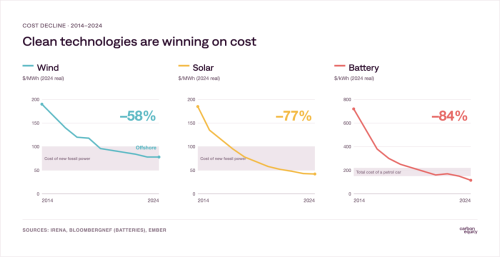
And it’s a dynamic that semiconductors, screens, and software also followed, going from expensive to commonplace over the last forty years. Fossil extraction is going the other way. The easy reserves are mostly gone, and each new barrel costs more to find and lift.
Resilience and independence are strategic assets
A few years ago, most investors assumed that critical inputs like fuel, metals, and components would always be cheap and available, even if they came from somewhere else. That assumption has taken a beating. Russia cut gas to Europe. China restricted rare earth exports. Supply chains froze in the pandemic, and the Iran war sent oil prices spiking again.
Countries and companies are responding the same way, building what they need closer to home. Larry Fink put it bluntly in his most recent letter: the old model of global capitalism is fracturing, and countries are spending enormous sums to become self-reliant in energy, in defense, in technology.
Three-quarters of the world's population lives in countries that import their fossil fuels. And 92% of countries have more than ten times their current electricity demand available in sunlight. Fossil fuels have to be imported and burned, over and over. Sunlight and wind, once you've built for them, cannot be taken away.
The age of AI
The computing power behind AI has been doubling roughly every seven months, growing more than ten-thousandfold since 2020. And the largest companies in the world are spending accordingly. Their combined capital expenditure on AI infrastructure passed $400 billion in 2025, and is set to rise another 75% in 2026.
But intelligence runs on electricity. Every model trained, every query answered, every AI agent set to work draws power. And the data centers behind them are now among the fastest-growing sources of electricity demand on earth. By 2030, the electricity drawn by data centres is set to double. In the United States alone, they're on track to consume more power than the production of aluminium, steel, cement, and all other energy-intensive goods combined.
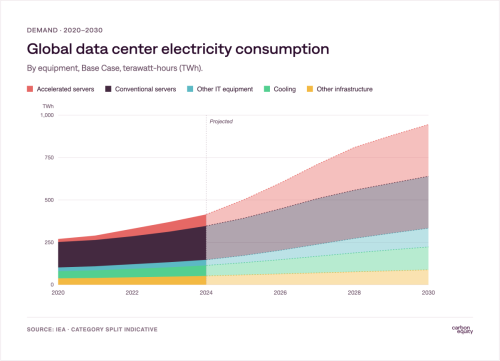
That power has to come from somewhere, and it has to come online fast, be reliable, and always on. Which is why the AI buildout is now one of the largest drivers of demand for everything the new economy makes: clean generation, grid capacity, long-duration storage, transformers, cooling, and critical minerals.
And it runs the other way too. Artificial intelligence is making the rest of the new economy smarter by balancing grids, optimizing factories, and discovering materials in months instead of years. AI doesn't just draw on the new economy; it accelerates it.
The new economy in the real world
Energy
From combustion to the electrification of (almost) everything
Electricity is becoming the backbone of the new economy. Solar and wind are now the cheapest electricity in history, and they get cheaper as we build more of them. The deployment curve has gone exponential.
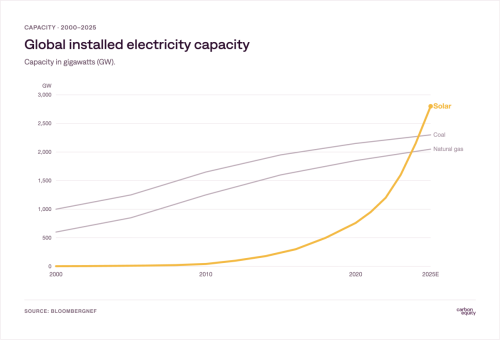
But the sun sets and the wind drops, meaning sometimes we have too much electricity and sometimes not enough.
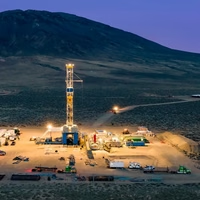
So the next frontier is reliable baseload power to ensure 24/7 availability. Next-gen geothermal is using horizontal drilling, the same technique that unlocked U.S. shale, to reach clean, constant heat that can be used for electricity (portfolio example: Fervo Energy). Small, modular reactors are being designed to be built in factories, not on construction sites, bringing nuclear's cost and timeline back into reach.
Grid capacity and electricity storage are now the bottleneck. But these technologies are starting to scale. Long-duration storage can now hold days of power instead of hours. Drones can now apply conductive coatings that unlock 20-30% more capacity from existing power lines, without rebuilding them (portfolio example: AssetCool).
As these systems get built out, electrification can power an increasingly large share of the economy. The result is cheaper, abundant power.
Industry
From fuel-based and rigid to efficient and more capable
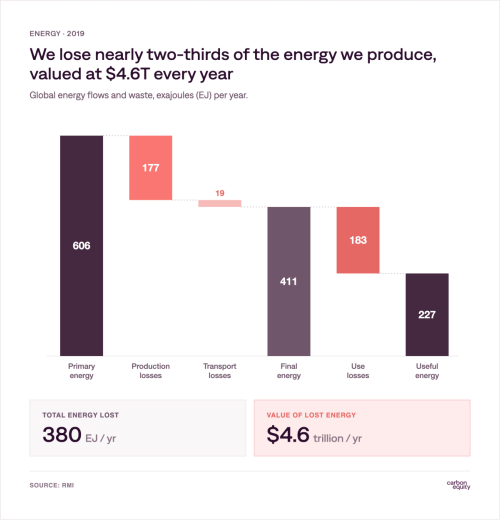
The factories of the new economy don't burn fuel, instead, they run (mostly) on electricity.
Most of the electrification conversation focuses on the consumer side: EVs, heat pumps, residential solar. But a massive shift and opportunity less people are talking about is happening in heavy industry. Steel, cement, and the high-temperature processes that underpin manufacturing are some of the biggest energy consumers globally. Most of it still runs on fossil fuels because we didn't have the technology to put electricity to use in high-temperature processes in a (cost) effective way. That bar is high, but clean technologies are starting to clear it.
A new generation of thermal storage systems can now absorb cheap renewable electricity and deliver it as heat at temperatures high enough for steel, glass, and chemicals (portfolio example: Rondo Energy). Cement is being made at ambient temperature using electrochemistry instead of combustion, without a kiln or fossil heat.
And where electrification is not possible in heavy industry, clean molecules step in. Hydrogen made from renewable electricity is starting to replace coal in steelmaking and gas in chemicals (portfolio example: Sunfire).
In a fragmenting world, energy has become a key strategic asset. As a result, countries are onshoring manufacturing to reduce critical dependencies. The US has seen over $400 billion in announced investment to onshore semiconductor and green energy manufacturing since 2022.* The EU has committed to producing 40% of its net-zero technology domestically by 2030. Battery cells, chips, transformers, and the critical materials they all run on.
The result is an industrial base that's closer to home, avoids shocks, and makes things the old one couldn't.
Materials
From dug-up commodities to engineered building blocks
The old economy assumed materials would always be cheap and readily available. In the new one, they're being engineered, designed, and increasingly local.
Metals that are lighter and more durable for wind turbines and electric motors. Denser battery chemistries with longer cycle life (portfolio example: LeydenJar). Catalysts that make clean hydrogen and carbon capture economically viable. Generative models running to design breakthrough molecular structures in months instead of decades (portfolio example: CuspAI).
But none of it works without the underlying minerals the new economy depends on, like lithium, cobalt, copper, rare earths, and silicon. And right now, they’re concentrated and processed in a small number of countries. And dominated by one. China didn't get here by accident, and countries won’t catch up fast. But that gap is an opportunity.
So securing them has become a strategic priority. Processing capacity is being built outside China for the first time in a generation. Innovative solutions, like sodium-ion batteries, help reduce the minerals required in battery storage. And recycling is becoming a real supply chain in its own right, pulling the materials we've already mined back into new batteries, motors, and electronics (portfolio example: Redwood Materials).
The result is secure supplies for the technologies we know are more efficient and cost-effective. And it's a materials base capable of more than what we can imagine today.
The new economy is being built in private markets
Roughly 1% of global companies are listed on the stock market. The other 99%, startups, growth companies, and infrastructure projects, you can only invest in them in private markets.
Investing works differently there, too. Buy a public stock and you're usually buying it from another shareholder: the shares change hands, but no new money reaches the company. In venture, growth, and infrastructure, your capital goes directly into research, hiring, manufacturing, and deployment. You're funding the value creation.
And this isn’t a niche market. Private funds are raising more than $160 billion a year for strategies financing the new economy.*
Companies are also staying private longer to do the building. The median age of a company at IPO is now 13 to 14 years, up from around nine for most of the last 40 years.* Meaning companies are larger, more profitable, and more developed before they reach the stock exchange — and a significant amount of their value creation has already happened. Global private capital has nearly tripled in the last decade to keep up.*
Ten years ago, many of the new economy technologies were still early-stage. Ten years from now, many will be mature public companies. Right now, we're in the scaling phase.
Key takeaway
Put it all together, and you get a clear road forward for the global economy, a generational investment opportunity, and a shift in what's possible.
Power that's cheap and abundant everywhere. Industries that have figured out how to make things without burning them. Materials designed for what they need to do, secured close to where they're used. And intelligence threading through the whole system, making each part work better as it scales.
And the byproduct? The shift toward electrification, more efficient industry, better materials, and smarter systems is the biggest lever we have to dramatically reduce greenhouse gas emissions. Whether you’re investing for that or not.
It won't move in a straight line. Rates and policies will shift timelines, shocks will change who wins, and many companies will fail. But once something is cheaper and better, customers don't go back. The direction holds.
Most investors will wait until it's obvious. By then, a lot of building will be done, and the next generation of market leaders will already be public, already priced. The companies defining the next decade are being built right now, in private markets, before the rest of the world catches on.
That's where we invest.
The sources shaping our thinking
Ember, The Electrotech Revolution (2025) · BloombergNEF, Energy Transition Investment Trends (2026) · IRENA, Renewable Power Generation Costs (2024) · RMI · IEA, Energy and AI (2025); The Implications of Oil and Gas Field Decline Rates (2025) · BlackRock, 2026 Chairman's Letter · PitchBook, Private Capital Indexes (Q4 2025) · Jay Ritter, University of Florida (IPO Statistics)
This is marketing communications. Carbon Equity does not offer any investment advice. Any performance data/information shared should not be seen as an indicator or guarantee of future performance. Investment opportunities offered by Carbon Equity are high-risk investments. You may lose part or all of your investment.
 3 min read
ESG is now Energy, Security, and Geopolitics
3 min read
ESG is now Energy, Security, and Geopolitics
The language around the energy transition is changing from moral to pragmatic. And that means something. We think it's worth understanding.
Read more 3 min read
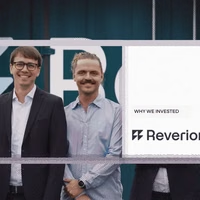
The same biogas, twice the power output: Why we invested in Reverion
3 min read
The same biogas, twice the power output: Why we invested in Reverion
Reverion builds modular power plants the size of a shipping container that can operate in both directions. Fed with biogas, it generates electricity at close to 73% efficiency in the field, against roughly 40% for the traditional engines installed on these plants.
Read more
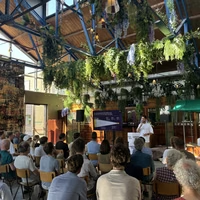
 NextGen Dinner: your role in the family's impact
An intimate dinner in Amsterdam for under-40s stepping into family wealth decisions. Hosted by PYM, with Carbon Equity, Julius Baer and Fair Capital Impact Fund.
6 min read
De Private Miljoenennota
Nederlandse huishoudens hebben samen ruim € 550 miljard aan spaargeld, meer dan de € 486 miljard die de overheid dit jaar uitgeeft. Tegelijkertijd zijn forse investeringen nodig om de Nederlandse economie te laten groeien en concurrerend te houden.
Lees meer