







The same biogas, twice the power output: Why we invested in Reverion

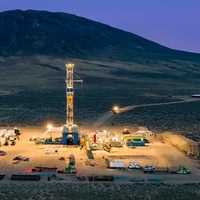
For years, Germany had one of the most advanced biogas industries in the world, with close to ten thousand biogas plants on farms and waste sites across the country.* Each takes the methane that comes off manure, crop waste, and food scraps, and burns it in an engine to make electricity. For two decades, that worked because the government guaranteed every plant a fixed price for its power. Those guarantees are now running out, with stricter regulations coming in.
Around 3,000 plants will lose their support by 2030*, and the rules they have to meet are ones a conventional gas engine simply cannot satisfy. The reason the old engine no longer works is that the German grid itself has changed. Wind and solar now swing the whole system between two extremes. Prices drop drastically when renewables flood the grid, and they spike when the wind drops and the sky goes dark.
The new rules pay a biogas plant to make power when it is scarce and to sit idle when it is not, and they demand far higher efficiency and far lower emissions than a traditional engine can deliver. The plants need to become flexible, and almost nothing on the market lets them do it economically.
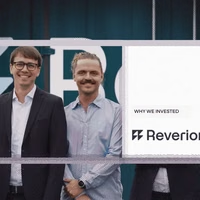
That gap is what drew us to Reverion, and it is why we are pleased to share that we have invested in the company alongside two of our relationship GPs, Energy Impact Partners, who led the seed and Series A rounds, and Extantia Capital. We have been tracking Reverion for a couple of years, waiting for the right terms and the right moment when the technology was de-risked and the company was ready to scale.
The unlock

Reverion builds modular power plants the size of a shipping container that can operate in both directions. Fed with biogas, it generates electricity at close to 73% efficiency in the field, against roughly 40% for the traditional engines installed on these plants.* That alone means nearly twice the power output from the same biogas. This is the key unlock for operators to comply with the new regulation.
Additionally, when the grid is awash with cheap wind and solar and prices are low or even negative, the same unit switches in under a minute and runs backwards, turning that surplus power into green hydrogen or synthetic methane that can be stored and sold at a later moment when prices are high. A single machine that is operational whether power is scarce or abundant. For a German operator, that two-sided plant is the difference between a stranded asset and a profitable business.
The plants’ ability to capture carbon also sets them apart from other products on the market. A normal biogas engine burns the gas and releases the carbon. Reverion captures it instead, in a pure stream ready to be stored or sold, at no cost to its efficiency.
A Reverion power plant makes more clean power, earns the operator more from the same feedstock, helps them clear the new emissions threshold, and is carbon-negative while doing it. The technology has been operating in the field for more than fifteen thousand hours, and it holds the world efficiency record for this kind of power plant.*

The long-term case
The company has already patented its processes. What's next is to scale its manufacturing capabilities and execute on its backlog of customer demand.
Pre-orders and letters of intent have been signed by blue-chip counterparties in Germany, and the company also has a $41 million carbon-removal agreement in place with buyers including Google, McKinsey, and H&M through Frontier Climate.*
Germany’s expiring biogas fleet is only the first large market. Other markets that stand to benefit from Reverion’s clean baseload power include data centres, shipping, and utility-scale storage and generation.
We couldn’t be more excited to support Stephan, Felix, Jeremias, Maximilian, Luis, and the entire Reverion team as they build the biogas plants of the new economy.
 3 min read
ESG is now Energy, Security, and Geopolitics
3 min read
ESG is now Energy, Security, and Geopolitics
The language around the energy transition is changing from moral to pragmatic. And that means something. We think it's worth understanding.
Read more 6 min read
De Private Miljoenennota
6 min read
De Private Miljoenennota
Nederlandse huishoudens hebben samen ruim € 550 miljard aan spaargeld, meer dan de € 486 miljard die de overheid dit jaar uitgeeft. Tegelijkertijd zijn forse investeringen nodig om de Nederlandse economie te laten groeien en concurrerend te houden.
Lees meer


 Masterclass investeren in energie en technologie - Huizen
Join us on the 16th of September for a special Investor Evening where you will hear directly from our team about our Climate Tech Portfolio Fund IV, its strategy and remaining allocation.
Masterclass investeren in energie en technologie - Haarlem
Join us on the 16th of September for a special Investor Evening where you will hear directly from our team about our Climate Tech Portfolio Fund IV, its strategy and remaining allocation.