






ESG is now Energy, Security, and Geopolitics

The language around the energy transition is changing from moral to pragmatic. And that means something. It's happening all around us, and it hasn't really been talked about. We think it's worth understanding why the wording is changing.
Most people's first assumption is that it's political. The new administration in Washington has repealed credits and made the vocabulary itself a liability. But that only explains why the old words disappeared; it doesn't explain the words that replaced them.
The old vocabulary put energy in a moral category, in its own conversation, with its own audience. Energy has always been broader than that; it's the backbone of the economy. Nothing gets made, moved, or heated without it. That was easy to overlook for as long as energy was cheap and easily imported.
Three megatrends brought it back into view. And they're the same three building the new economy.
- Electrification is rewriting the economics of energy. What used to carry a green premium is now often the cheaper, faster, and more efficient option.
- Resilience and independence have become strategic assets. We went from wanting to be green to needing to be independent, and it turns out those lead to the same things.
- The age of AI is driving demand for baseload power that is always on and online fast.
You can dive deeper into these megatrends here.
The language used to pitch the energy transition is giving way to the everyday language of the economy. The technologies didn't change, and neither did the direction of travel. What changed is the priority they now sit under, and who they get pitched to. The case used to be made to the sustainability officer, and now it's also made to the CFO and COO.
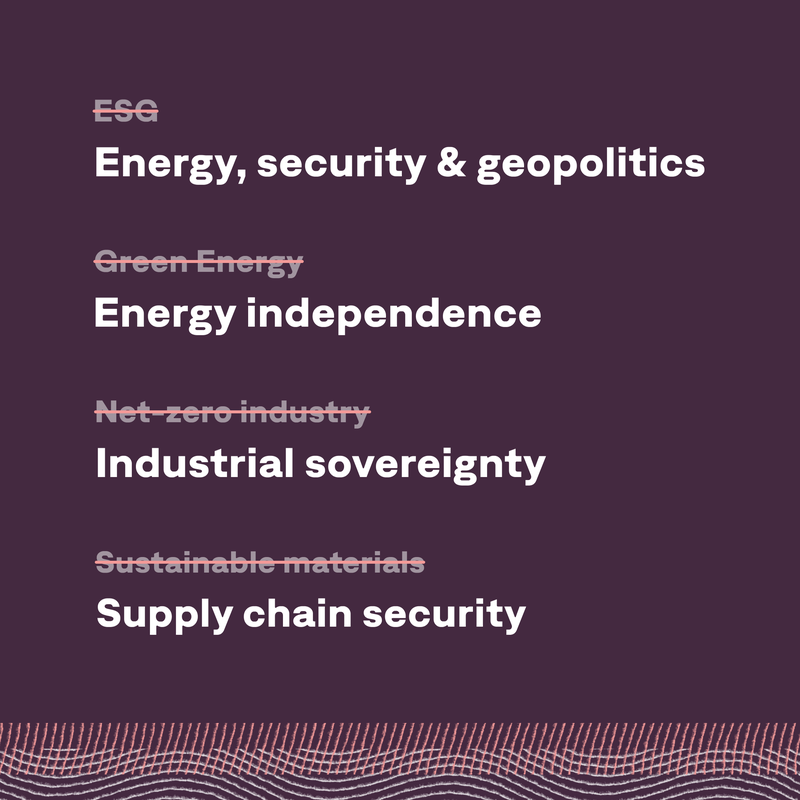
It can feel off for those who have built the moral movement, but it’s making the technologies more relevant to more people.
And it’s happening at different layers of the global economy
Markets
Washington raised tariffs, took away credits, and froze permits. Nine out of ten megawatts built in America in the first half of this year were solar, wind, or storage anyway.* So while the subsidies disappeared, the demand didn't.
Buyers
Amazon is targeting more than 5GW of small modular reactors in the US by 2039.* Google is funding battery storage in Minnesota that can run for a hundred hours.* Hyperscalers bought clean power to count against a target. Now it's also how they get reliable power fast.
Reporting
European companies are mentioning extreme heat and drought in their quarterly reporting at more than double the previous record.* Mentions of climate change and related terms have fallen by roughly four-fifths since 2021, back to pre-2019 levels. The abstraction dropped out, and the effects took its place.
Allocators
BlackRock's Larry Fink spent the early 2020s arguing that climate risk is investment risk.* His recent letters argue for energy pragmatism, and the case he makes is permitting timelines and energy security.
Governments
Europe's plan to double electrification is described as an investment and independence plan. The largest climate bill ever passed in America was called the Inflation Reduction Act. Both focused on energy because it's the foundation of the economy. When energy is expensive and unreliable, inflation rises, and both were written to do something about it.
While the change in language wasn’t announced on TV or written up in a memo, the words have been appearing around you. Energy independence in the paper, supply chain risk in your bank's outlook, or sovereignty from a politician who would never call it a transition.
The vocabulary changed, but the underlying transition never stopped. What changed is the business case. Electrons got cheaper, data centers got hungry, and imported energy started looking like a liability. Once those were true, the moral case stopped being the strongest case available, so people stopped making it.
Climate was argued in its own category, while the things it was building — energy, industry, and materials — have always been the backbone of the economy.
This is what it feels like when a movement starts to reach broad market adoption. And while it will stay gradual, with its ups and downs, this is what the new economy sounds like while it's being built.
Note: The three megatrends won't lift everything equally. What sits inside them can scale faster. An example that sits outside them for now is carbon removal. The tech matters, but it still carries a premium and is harder to fund. Also, US policy decisions have made scaling certain technologies harder, and in the short term, meeting AI's power demand means more gas.
 3 min read
The same biogas, twice the power output: Why we invested in Reverion
3 min read
The same biogas, twice the power output: Why we invested in Reverion
Reverion builds modular power plants the size of a shipping container that can operate in both directions. Fed with biogas, it generates electricity at close to 73% efficiency in the field, against roughly 40% for the traditional engines installed on these plants.
Read more
 NextGen Dinner: your role in the family's impact
An intimate dinner in Amsterdam for under-40s stepping into family wealth decisions. Hosted by PYM, with Carbon Equity, Julius Baer and Fair Capital Impact Fund.
6 min read
De Private Miljoenennota
Nederlandse huishoudens hebben samen ruim € 550 miljard aan spaargeld, meer dan de € 486 miljard die de overheid dit jaar uitgeeft. Tegelijkertijd zijn forse investeringen nodig om de Nederlandse economie te laten groeien en concurrerend te houden.
Lees meer

 Op bezoek bij LeydenJar: van lab naar fabriek
De meeste batterijen komen nu nog uit Azië. Maar in Eindhoven maakt een Nederlandse technologie die de samenstelling van batterijen kan veranderen, de stap van het lab naar de fabriek.