










Finding room on the grid without building new power plants: Why we invested in Voltus

America is running short of electricity. Demand is rising faster than the grid can deliver as transport, heating and industry electrify. On top of that, AI data centres are coming online at speed: their demand alone is expected to more than double, from almost 50 GW in 2025 to 118 GW in 2030 (BloombergNEF, 2026).
New supply cannot keep up. New solar, wind and storage projects often have to wait two to five years or more to connect to the grid, and new nuclear will not arrive before the 2030s. For other new power generation, large gas turbines are largely booked until the end of the decade. The shortage is already showing up in prices. In PJM, the largest grid operator in the US, serving 65 million people across 13 states, the price of reserving power capacity rose more than tenfold in two years. Those costs end up on the bills of households and businesses.
Most of the time, though, the grid has room to spare. It is sized for the handful of hours each year when demand peaks, on the hottest summer afternoons and the coldest winter evenings. If enough electricity users briefly reduce or shift their consumption in those moments, the same grid can serve far more demand without a single new power station. Flexibility is the fastest power plant you can build, while it also helps keep prices down for all electricity users. That is what drew us to Voltus, and why we are pleased to share that we have co-invested in the company’s Series D alongside Activate Capital, one of our relationship GPs, who also led Voltus’ Series C.
The unlock

Voltus is the leading virtual power plant operator in North America. A virtual power plant does not burn or generate any energy. It connects thousands of businesses that use a lot of electricity, such as big-box retailers, steel plants, universities and cold storage warehouses, and combines their flexibility into one large resource that the grid can call on. When the grid is under strain, Voltus sends a signal. Each site briefly turns down equipment, shifts a process or switches to an on-site battery. The grid operator pays for that reliability, and Voltus shares the income with its customers.
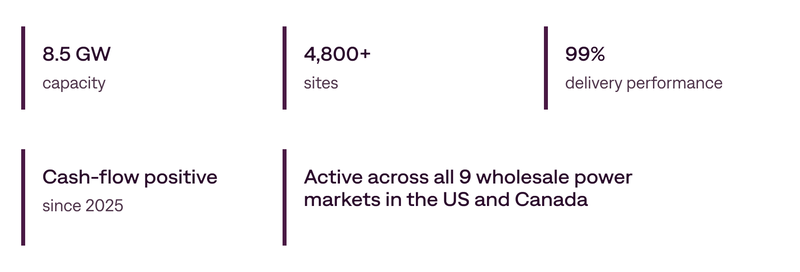
Voltus’s advantage is the platform behind it. A small metering device at each site and software built over ten years let it operate in all nine wholesale electricity markets in the US and Canada, each with its own rules. Voltus can also sell the same flexibility into several programmes at once, which competitors do not do. Today it manages around 8.5 GW of capacity across more than 4,800 sites, and has consistently delivered close to 100% of what it committed to.
The newest part of the business is “Bring Your Own Capacity”. Grid operators increasingly expect large new loads like data centres to secure their own capacity before they connect. Voltus offers data centre operators the fastest way to do that. It signs long-term contracts directly with them and delivers flexible capacity in months, whereas new generation would take years. In October 2026, Google expanded their 100MW pilot tenfold to a 1 GW virtual power plant in PJM, one of the largest distributed capacity portfolios a hyperscaler has deployed to date (Voltus, 2026).
A strong syndicate and the right moment
We have known Voltus through Activate. The round is led by Generation Investment Management, alongside Activate and Vitol, joined by several strategic investors. The round was heavily oversubscribed, and our relationship with Activate secured our allocation. Voltus became cash-flow positive in 2025 and does not expect to need further outside capital.
The long-term case
Electricity demand in the US is rising for the first time in decades, driven by data centres, electrification and reshoring of industry. Every new megawatt of demand has to be met somehow. Freeing up the existing grid is the fastest and often the cheapest way. It also matters for the communities around data centres. Voltus turns their arrival into income for local businesses, rather than new infrastructure costs that end up on everyone’s bill. That makes it a solution regulators are increasingly designing their markets around.
It is also a strong climate solution. Every hour that flexibility covers a peak is an hour a gas “peaker” plant does not have to run, and more flexibility makes it easier for the grid to absorb wind and solar. RMI estimates that virtual power plants could avoid 44–59 million tonnes of CO2 per year in the US by 2050.*
Voltus is led by co-founders Dana Guernsey (CEO) and Matthew Plante (President), both veterans of the demand-response industry. Its Chief Regulatory Officer is Jon Wellinghoff, the longest-serving former chairman of the US Federal Energy Regulatory Commission.
We are proud to be backing Voltus alongside Activate and Generation. We will keep you updated as it builds the smarter and faster energy system of the future.
 3 min read
ESG is now Energy, Security, and Geopolitics
The language around the energy transition is changing from moral to pragmatic. And that means something. We think it's worth understanding.
Read more 3 min read
The same biogas, twice the power output: Why we invested in Reverion
Reverion builds modular power plants the size of a shipping container that can operate in both directions. Fed with biogas, it generates electricity at close to 73% efficiency in the field, against roughly 40% for the traditional engines installed on these plants.
Read more
6 min read
De Private Miljoenennota
Nederlandse huishoudens hebben samen ruim € 550 miljard aan spaargeld, meer dan de € 486 miljard die de overheid dit jaar uitgeeft. Tegelijkertijd zijn forse investeringen nodig om de Nederlandse economie te laten groeien en concurrerend te houden.
Lees meer