











Climate Tech Portfolio Fund IV closes on December 31. Here's what's inside.

A truck maker with an order for 2,000 electric trucks from FedEx. Data center cooling that cuts energy use by up to 45%, sold out for years. A geothermal company selling around-the-clock power to Google and California utilities. All three are in Climate Tech Portfolio Fund IV, which will close at the end of the year.
From pilots to paying customers
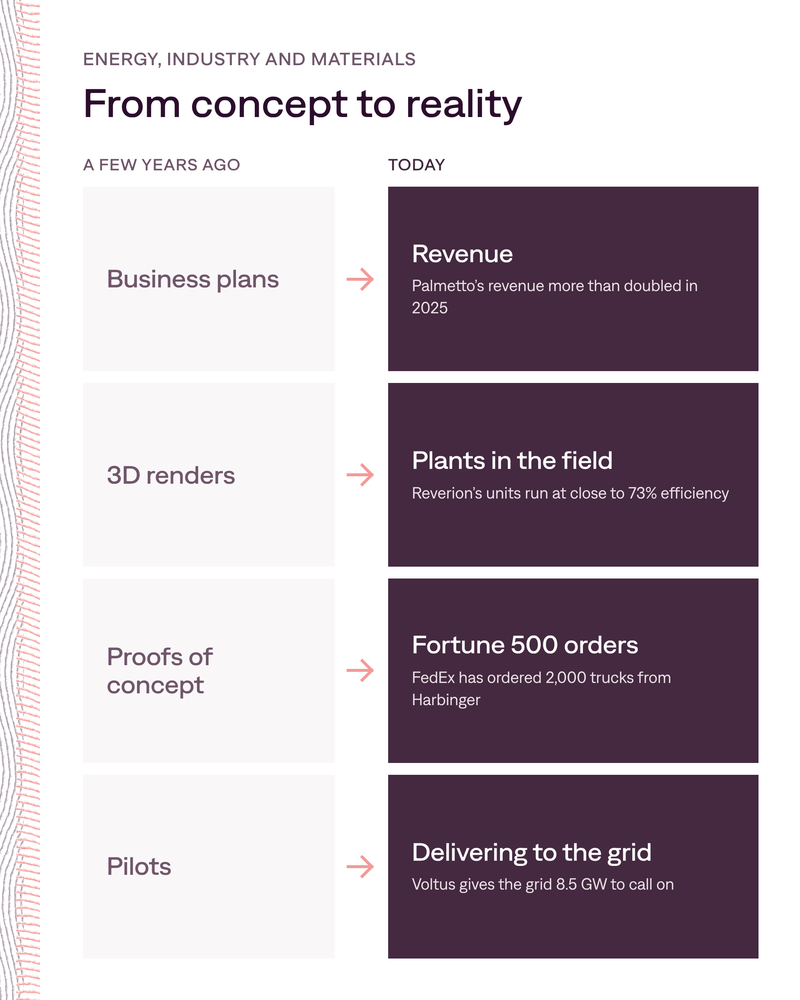
A few years ago, many energy, industry and materials companies building the new economy were business plans, 3D renders and pilot projects. Today, companies in Fund IV run commercial plants, deliver power to the grid and take orders from some of the world’s largest companies.
The market for these companies now runs on demand. Data centers need more power and better cooling. Grids need capacity they can add quickly. Businesses and households want lower, more predictable energy bills, and governments want energy they control. Buyers pay for technology because it is cheaper, faster or more reliable than what it replaces. That it’s cleaner is also part of the deal.
That demand is where we invest with Fund IV.
What’s inside Climate Tech Portfolio Fund IV
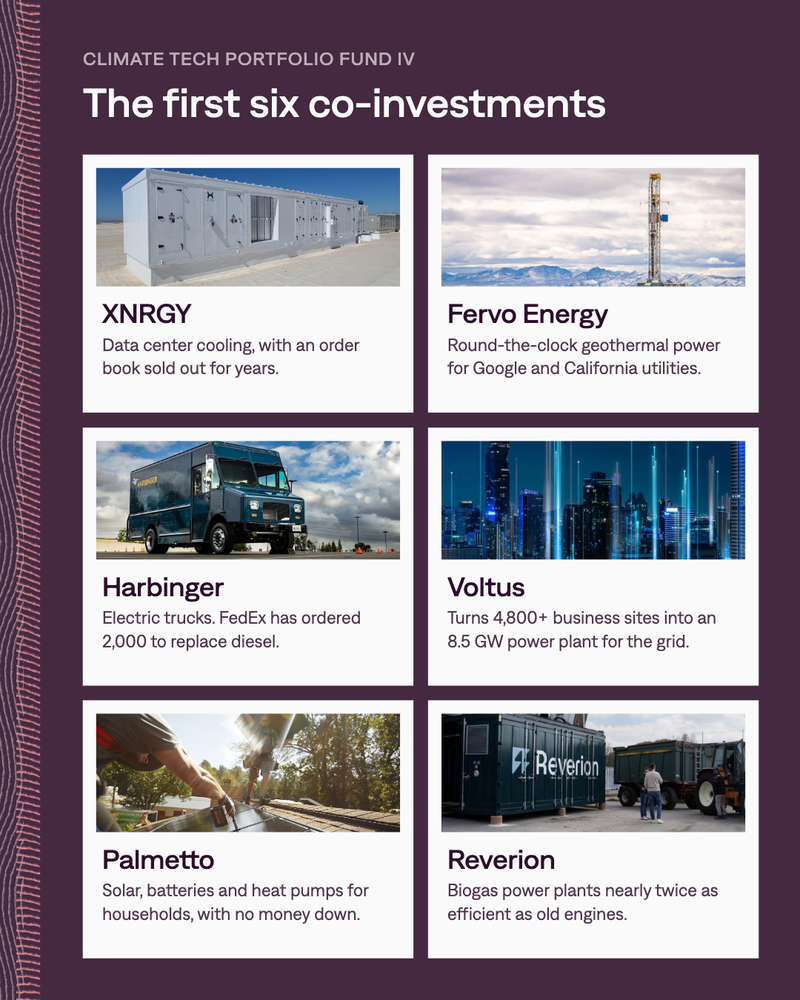
Ahead of the final close, Fund IV has already committed to seven funds and co-invested directly in six companies. The fund’s investment strategy aims to give its investors exposure to 150+ companies once fully invested.
The six co-investments were handpicked by our investment team, and showcase the type of companies we want in Fund IV.
A selection of companies already in
Data centers and the grid
Cooling is the biggest energy cost in a data center outside of the computing itself. XNRGY builds cooling systems that cut that energy use by up to 45% for data centers, hospitals and EV battery plants. Its order book is sold out for the coming years. In June, Bloomberg reported that XNRGY is exploring a sale.
When the grid runs short, Voltus pays businesses to use less. It pools flexibility from more than 4,800 commercial and industrial sites, giving the grid around 8.5 GW to call on. It is North America’s largest virtual power plant operator by capacity, and has been cash-flow positive since 2025.
Fleets
FedEx has ordered 2,000 electric medium-duty trucks from Harbinger, worth more than $300 million, to replace diesel vehicles in its US and Canadian delivery fleet by the end of 2027. Harbinger estimates each truck saves around $20,000 a year in fuel, roughly $40 million a year across the fleet. FedEx also co-led Harbinger’s $225 million Series C, alongside Capricorn and Tiger Global.
Households
Palmetto takes the upfront cost out of going electric at home. Households get solar panels, batteries, heat pumps and EV chargers for no money down, on a monthly plan below their existing utility bill. Revenue more than doubled in 2025, and the company is profitable. As of Q1 2026, it’s the largest third-party owner of residential solar in the US.
Baseload power
California utilities, Shell and Google are contracted to buy power from Fervo Energy. The first 500 MW at its flagship geothermal project is fully booked, and in September Google signed for nearly 400 MW more for a planned data center in Utah. Geothermal runs around the clock, so it could be a critical piece in solving intermittency. In May 2026, Fervo listed on Nasdaq.
Reverion builds container-sized power plants that run in both directions. On biogas, they reach close to 73% efficiency in the field, nearly twice that of the engines they replace. When wind and solar flood the grid, the same unit switches in under a minute to making hydrogen or methane for storage.
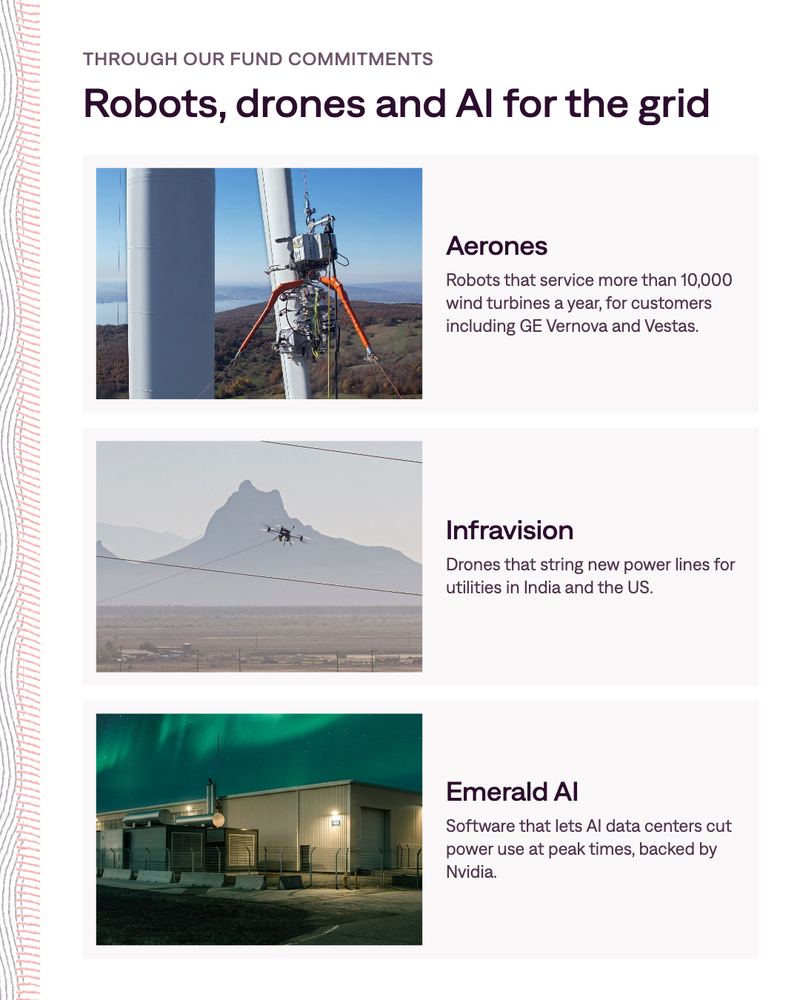
Through our fund commitments, Fund IV also holds stakes in companies such as:
- Aerones, whose robots service more than 10,000 wind turbines a year for customers including GE Vernova and Vestas
- Infravision, which uses drones to string new power lines for utilities in India and the US
- Emerald AI, whose software lets AI data centers cut their power use at peak times so they can connect to the grid faster, with Nvidia as investor and partner
The underlying funds
Of the 700+ funds we track, these were the managers raising capital that our team wanted in Fund IV. None of these funds are easy to get into as a private investor, but through Fund IV, you can get exposure to all seven, starting from €100,000.
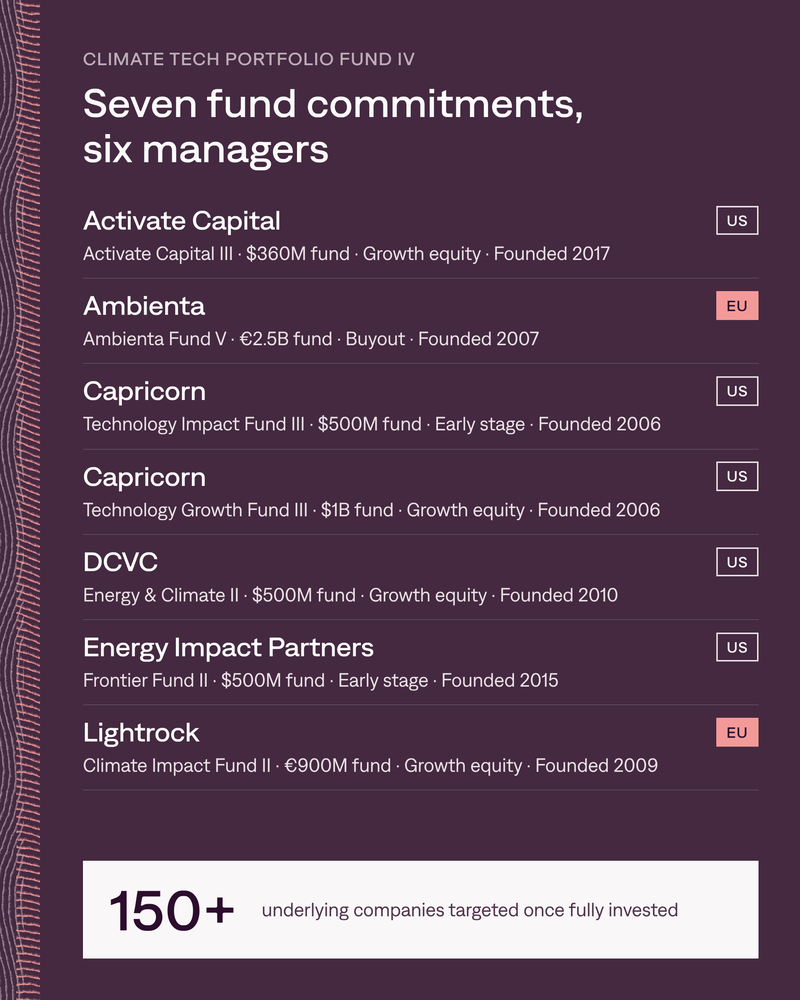
Capricorn Investment Group is one of the top-performing climate VC managers globally. Its two partners have led the same strategy for twenty years and backed Tesla, SpaceX and QuantumScape when they were still early bets. And they have already returned significant cash to investors from earlier funds.
Energy Impact Partners is backed by more than 75 energy and industrial companies. Its first Frontier Fund closed oversubscribed at $485 million, and the companies in it have since raised at substantially higher valuations.
The other four, in brief:
- Ambienta, one of Europe’s top impact buyout managers, closed its fourth fund oversubscribed at its €1.55 billion hard cap.
- DCVC manages more than $4 billion across 13 funds raised since 2010, and its first climate fund backed Fervo before its IPO.
- Activate Capital has made 12 investments from its third fund so far, and several have since raised follow-on rounds at higher valuations.
- Lightrock’s first climate fund closed oversubscribed at €860 million, well above its €600 million target.
Early traction
It’s far too early to judge Fund IV on financial performance, but the first signs are positive. The portfolio companies already selected have reached technical milestones and are gaining commercial traction. Some of them are described in this article. As of Q2 2026, Fund IV’s first 19 investments are valued at 3.2x what the fund paid in, before fees and costs.
However, that figure covers only around 15% of the final portfolio, at a very early stage of the fund. The fund is still raising and will be in the investment phase for some years. The valuations are unrealized, and they will change, up or down, as the portfolio grows and companies raise new rounds or are sold. Past performance is not a reliable indicator of future results. Investments in private companies are high-risk and illiquid. Returns are not guaranteed, and you may lose some or all of your investment.
Final close on December 31
More than 200 investors have committed over €60 million to Fund IV so far. Across all our funds, Carbon Equity now has 2,000+ investors and nearly half a billion euros under management.
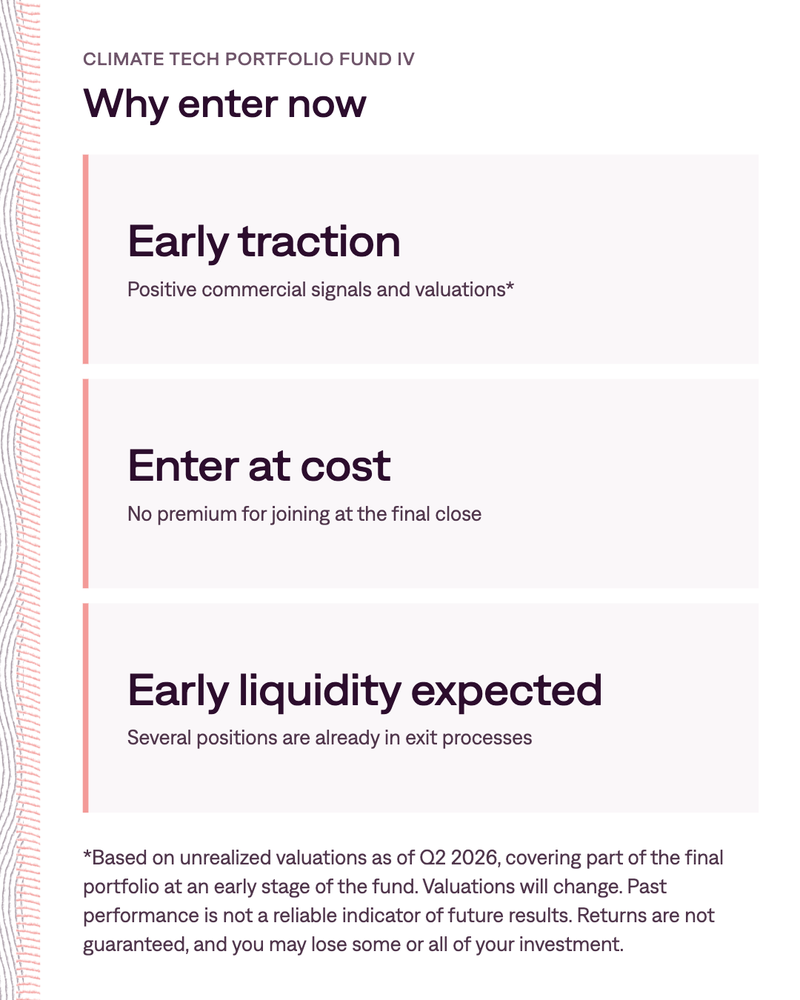
The final close of Fund IV is coming up quickly. If you join before then, you enter at cost, with no premium for coming in late. Fund IV also charges no performance fee. For more information on costs, please refer to the Information Memorandum.
Reserve your investment → or talk through your next steps with Berend at berend@carbonequity.com or +31 (6) 36 13 96 72.
Already invested in Fund IV? You can increase your commitment → before the close.
This is a marketing communication. Carbon Equity does not provide investment advice. Please refer to the Information Memorandum of the fund and to the EID before making any final investment decisions. Investments made via Carbon Equity or its funds are high-risk, and you may lose some or all of your investment.
 3 min read
Finding room on the grid without building new power plants: Why we invested in Voltus
Voltus is the leading virtual power plant operator in North America. It connects thousands of businesses that use a lot of electricity and combines their flexibility into one large resource that the grid can call on.
Read more 3 min read
ESG is now Energy, Security, and Geopolitics
The language around the energy transition is changing from moral to pragmatic. And that means something. We think it's worth understanding.
Read more
3 min read
The same biogas, twice the power output: Why we invested in Reverion
Reverion builds modular power plants the size of a shipping container that can operate in both directions. Fed with biogas, it generates electricity at close to 73% efficiency in the field, against roughly 40% for the traditional engines installed on these plants.
Read more
6 min read
De Private Miljoenennota
Nederlandse huishoudens hebben samen ruim € 550 miljard aan spaargeld, meer dan de € 486 miljard die de overheid dit jaar uitgeeft. Tegelijkertijd zijn forse investeringen nodig om de Nederlandse economie te laten groeien en concurrerend te houden.
Lees meer